
Why your PDA child won't go outside, and what to do
Jan 02, 2026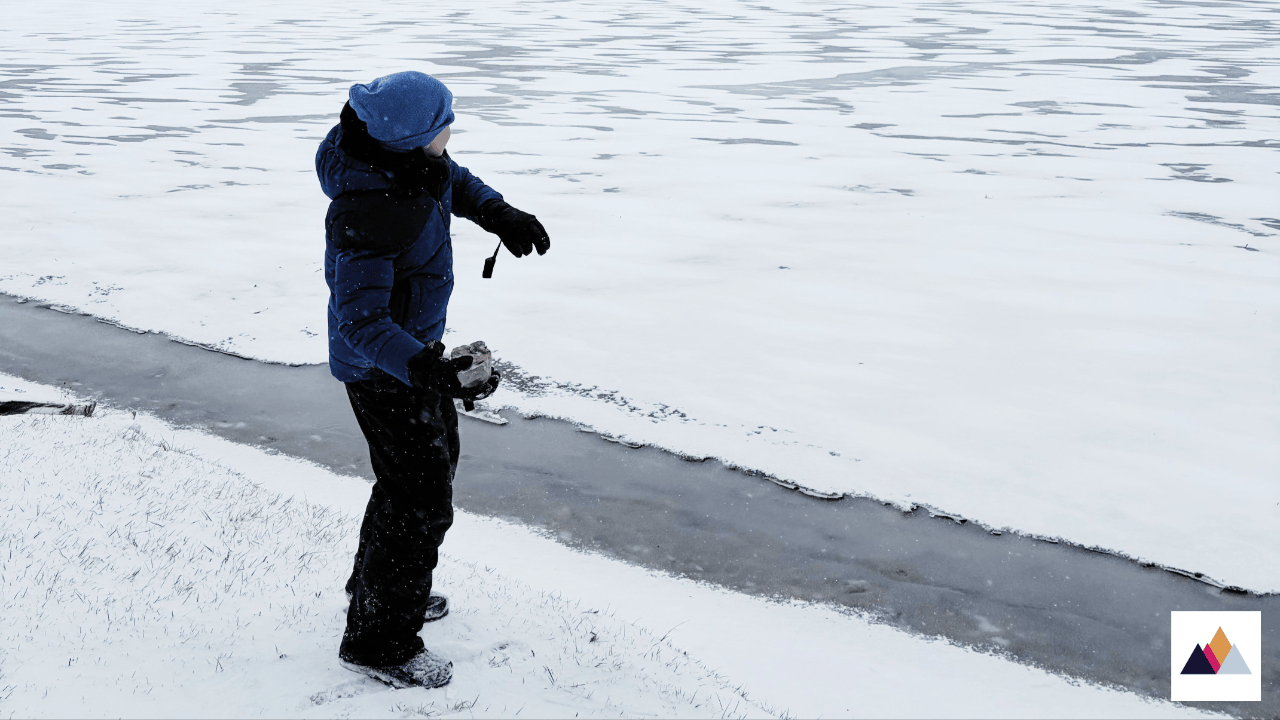
Many parents of children with pathological demand avoidance (PDA) struggle with outdoor refusal. The more they encourage, the more their child resists.
Here is what may actually be driving that refusal, and what can help over time.
* * *
A few days ago, the temperature dipped here in Michigan to turn the freezing rain into real snow again.
My older PDA son Cooper looked out the window and announced that he wanted to go to a small public lake about a five minute drive from our house to check the depth of the ice.
He was determined to calculate how many cold days it would take before the lake would be safe for ice fishing (his new obsession, and one that gives me heart palpitations!).
I layered on my snow gear and we headed out into the blustery white day.
We spent the next hour enveloped in the quiet of the frozen lake and watched the snow blow across it horizontally, almost like smoke on a mirror.
Together, we collected rocks and large walnut seeds that Cooper could catapult onto the lake's surface, listening to the different sounds they made.
The moss on a birch tree caught our attention for a few moments, and then we gathered sticks to move across the water's edge so we could listen to the slush sound it made while exposing the pebbles below.
I walked around the park marveling at the stark beauty we had all to ourselves.
On the drive home, I recognized a sign for a small nature area and it raised an unpleasant memory from over six years ago.
I briefly felt in my body the fear of that time - the thought that my son would never enjoy nature, go outside, or have enough regulation to appreciate the outdoors.
There were so many times that I tried to force him to "hike" with me at that small nature center, pushing him to be outside, incentivizing him with printed scavenger hunts.
We even pretended that there was a "hiking fairy" that left skittles and m&m's along the path to keep his little legs moving.
Of course, the more we encouraged, the more he would meltdown, refuse, say his legs didn't work, and collapse on the ground, and we would end up carrying him out writhing and screaming.
We constantly felt the sting of defeat and confusion.
I eventually gave up on this idea of "enjoying nature" or "taking walks." And of course, there was grief there.
What I didn't understand at the time was that what a PDA child can access and be interested in when they are in burnout or near their threshold of tolerance is not a "forever" situation, nor is it a reflection of their temperament.
Although at the time I felt like I was "giving up," what I was actually doing - unbeknownst to me - was finally radically accepting what was true in the present moment.
I accepted that his nervous system couldn't handle the loss of autonomy of me pressuring or forcing him out of his safest space and preferences before making a true paradigm shift in my parenting.
But over time - yes, years - the accommodations we implemented increased his window of tolerance.
He started spending more time in his thinking brain.
He started to trust on a subconscious level that we would never force him. And he could observe with autonomy what his father and I valued and engaged in (being outdoors when possible!).
I share this as a gentle reminder that often what feels like "giving up," is actually a needed surrender to what is true now.
Parents often feel this as rock bottom, but it is moving out of denial of the truth of the present moment.
And when we release the energy of trying to control something we can't, it actually makes more space in the nervous system and relationship for a PDA child to explore and expand.
The hard part for us parents, though, is that it isn't a quick fix, a skill you can teach your child, or a strategy that once you implement a few times dramatically changes everything.
That's not really how the big, important things in life work. Relationships, trust, felt safety, and acceptance of another human are a long-term practice.
Don't give up hope, my friends!
Your glimmers and progress are waiting on the other side of acceptance.
Happy 2026.
Want my blog posts in your inbox?
Most weeks we send two emails. You can unsubscribe any time.
